Photograph it where you stand
Use your phone camera or upload a photo you already took. It runs in a mobile browser, so there is nothing to install before you can look something up.
Waitlist open
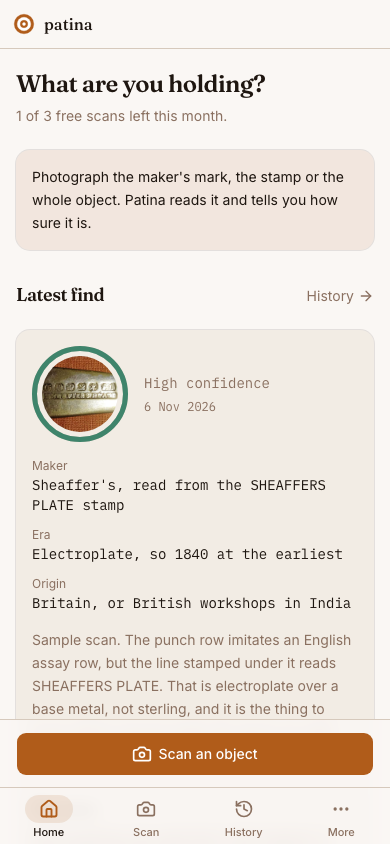
Patina reads the mark on the base, the stamp on the back, the shape of the whole piece, and returns maker, era and origin in plain English. When it is not sure, it says so and points you toward an appraiser.
A look inside
The problem
A professional appraisal is thorough, and it is also commonly quoted in the two to five hundred dollar range per item, with days of waiting attached. General image search is free and instant, and it cannot read a maker's mark, an assay stamp or a style period at any useful depth. So most finds get decided by gut feel at the table, with the seller waiting and the queue moving. Patina is built for that moment: enough domain knowledge to name what is in front of you, and enough honesty to tell you when the answer is worth paying a person for.
How it will work
Capture with the camera or upload a photo from your library. The mark on the base is usually the most useful single frame, though a whole-object shot works when there is no mark to find.
The image goes to a multimodal vision model, which returns maker, era, origin and how confident it is in that reading.
No jargon wall and no dollar figure. A disclaimer stays visible on the result so you always know you are reading an estimate rather than an appraisal.
Below the confidence threshold, Patina stops guessing and flags the item, with a link to a vetted appraiser who can look at it properly.
Your last ten results stay in history, so you can compare what you saw at two different tables without writing anything down.
What it will do
For what it covers, see the pages this site publishes.
Use your phone camera or upload a photo you already took. It runs in a mobile browser, so there is nothing to install before you can look something up.
A multimodal vision model reads the image and returns maker, era, origin and a confidence level, rather than a single vague label.
When confidence falls below the threshold, the result is flagged and you get a referral link to a vetted appraiser. Identification is our job; valuation belongs to a person.
The ten most recent results stay in your history, so the piece you looked at on Saturday morning is still there when you get home.
Every account gets three scans per calendar month at no cost, which is enough to try it on objects you already know the answer to.
Email and password, or a magic link if you would rather not keep another password. Your history and quota live behind that account.
Who it is for
For who it covers, see the pages under Who it is for.
Estate sale regulars
Built for the moment a piece is in your hands, the price is on a sticker, and nobody nearby can tell you whether the mark on the base means anything.
Collectors
Made to sit alongside what you already know. Patina names the maker and era it reads, and you decide whether that matches the object in front of you.
Thrift and car boot shoppers
For rails and shelves of unlabelled things, where the cost of looking closer is your own time and the cost of walking past could be the find.
People sorting an inheritance
Made for the boxes that arrive with no paperwork, where the first useful step is knowing which few pieces deserve a professional appraisal.
Questions
No, and it never will. Patina identifies maker, era and origin, and it does not produce a dollar value or price estimate. Valuation is a professional's job and we say so on every result.
Every result is an AI-generated estimate, not an expert appraisal, and it should not be the sole basis for a purchase or sale decision. That is why each result carries a confidence level and a persistent disclaimer, and why low-confidence results are flagged rather than dressed up.
When the model's confidence falls below the set threshold, the result is flagged and you are given a referral link to a vetted appraiser. It is a handoff, not a verdict.
Not at launch. Patina runs as a mobile-first web app you open in your phone browser, with camera capture or photo upload built in. Native app store distribution is not part of this build.
A photo you submit is sent to a multimodal vision model to produce the identification, and your ten most recent results stay in your own signed-in history. The privacy page sets out the detail.
Yes. Scans are tied to an account so your monthly quota and your history work, and you can sign in with email and password or a magic link.
Patina is pre-launch and the waitlist is open. Join it and we will write to you when scanning opens, with no other mail in between.
From the blog
A British silver hallmark is usually four separate punches: sponsor's mark, standard mark, town mark and date letter.
Leave an email and we will tell you when Patina opens for scanning. One message at launch, nothing else in between.
One email when it launches, and one now to confirm your address. Unsubscribe any time. Privacy.